Purpose
The purpose of this report description is to explain how to generate the Salary Increase Monitoring Report.
Report Description
This report provides Salary Increases with annual and prior salaries statewide across agencies for all employees except temps.
The salary increases in this report are provided for specific Action Types like New Hire, Promotion, Reinstatement/Reemployment, Non-Beacon to Beacon, Transfer, Appointment Change, Reallocation, Salary Adjustment, Range Revision, Career Progression, and Band Revision.
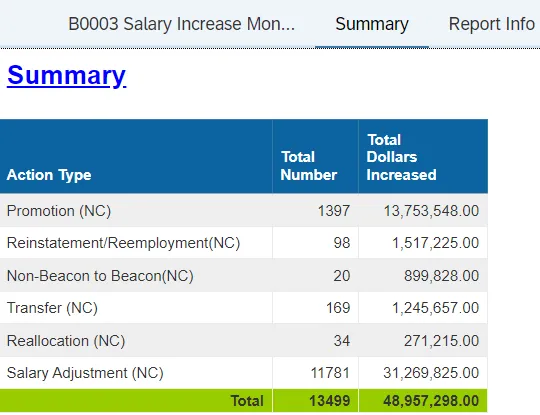
A second report tab provides the summary of Actions and Total Dollars Increased by Action Type. New Hires are excluded in the summary Tab.
Report Location
OSHR Executive Oversight
Report Uses
- For monitoring compliance to policy for most salary increases.
- Action Monitoring for Executive Requests.
- Use Compa Ratio to evaluate, either at a summary or detail level, how employee salaries are increased within their specific job market.
How to Generate This Report
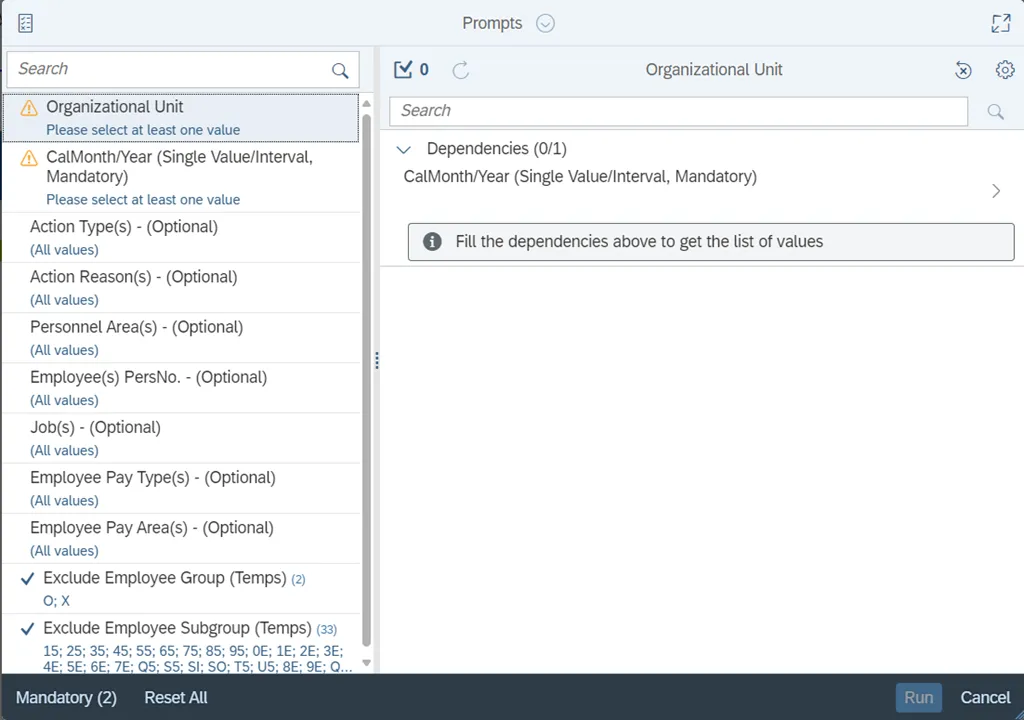
This report is generated after selecting values for the mandatory prompts. All mandatory prompts must have values selected before the Run Icon can be used to generate the report. Mandatory prompts can be identified as mandatory by the exclamation mark inside of the yellow-orange triangle, the square with the checkmark, or the display of (Mandatory). Detailed instructions for interaction with each prompt can be found on the Web Intelligence Prompt List on the OSC website.
Mandatory Prompts
- Organizational Unit
- CalMonth/Year (Single Value/Interval, Mandatory)
- This mandatory prompt must be completed first before any other prompt is selected.
This report can also be further limited by utilizing the Optional prompts to further limiting the amount of data that retrieved into the body of the report. Optional prompts are indicated as optional in parentheses beside the prompt.
Optional Prompts:
- Action Type(s) – (Optional)
- Action Reason(s) – (Optional)
- Personnel Area(s) – (Optional)
- Employee(s) PersNo. – (Optional)
- Job(s) – (Optional)
- Employee Pay Type(s) – (Optional)
- Employee Pay Area(s) – (Optional)
Exclusion prompts exclude specified data by default while allowing customers the flexibility of changing them when necessary. Exclusion prompts are identified by the term Exclude followed by the prompt.
Exclusion Prompts
- Exclude Employee Group (Temps)
- Exclude Employee SubGroup (Temps)
Initial Layout
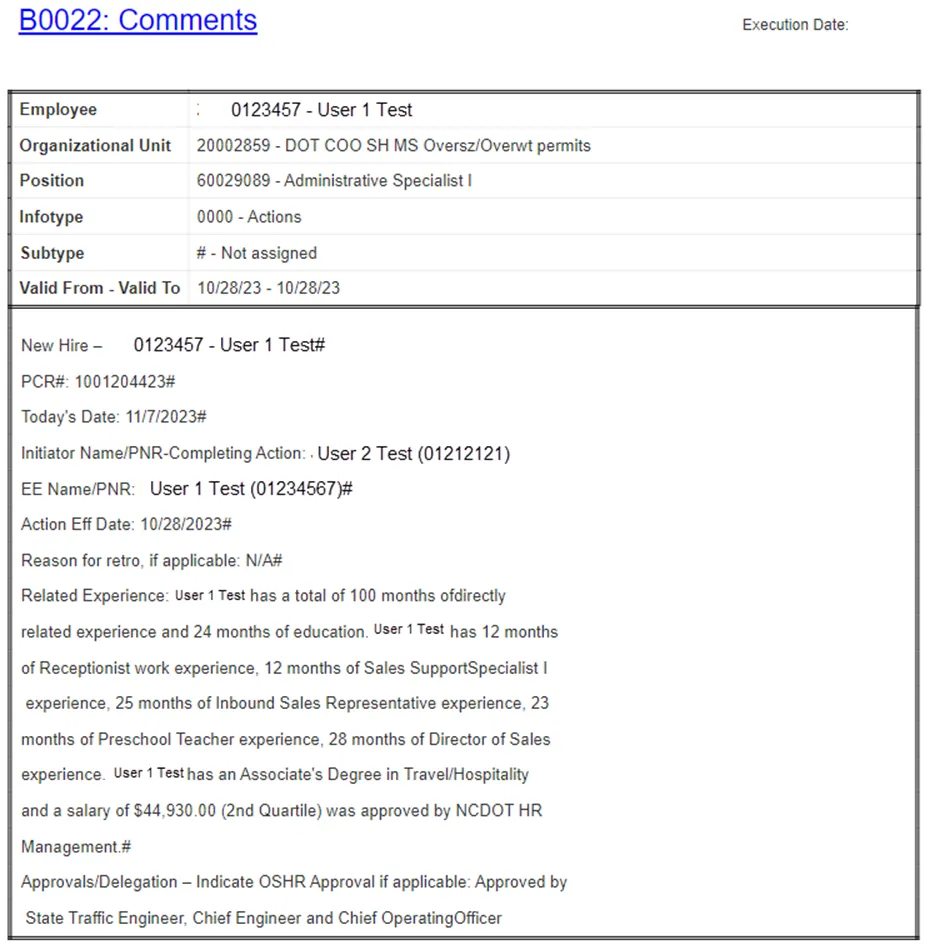
There are two report tabs available as well as the Report Info tab. Below are sample renderings from each tab.
- Salary Increase Monitoring Report: This report provides Salary Increases with annual and prior salaries statewide across agencies for all employees except temps. The salary increases in this report are provided for specific Action Types like New Hire, Promotion, Reinstatement/Reemployment, Non-Beacon to Beacon, Transfer, Appointment Change, Reallocation, Salary Adjustment, Range Revision, Career Progression, and Band Revision.
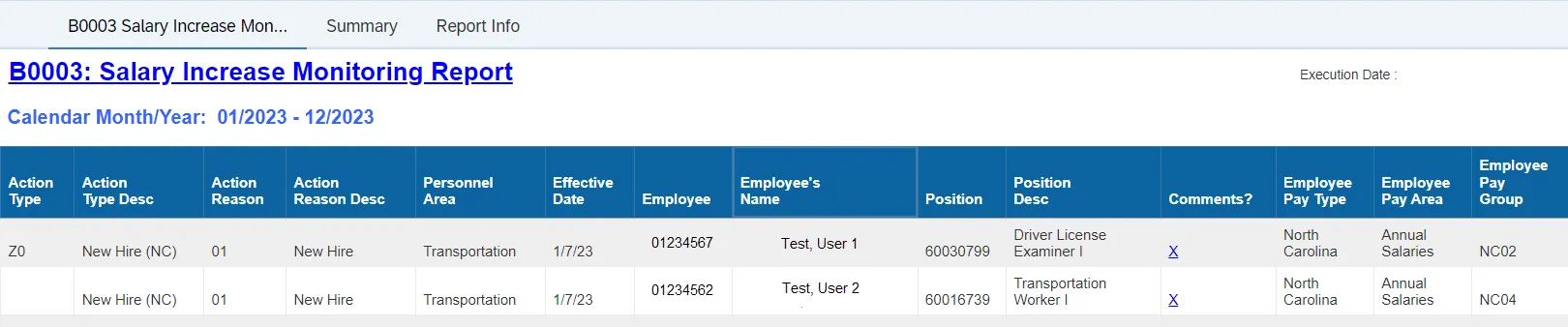
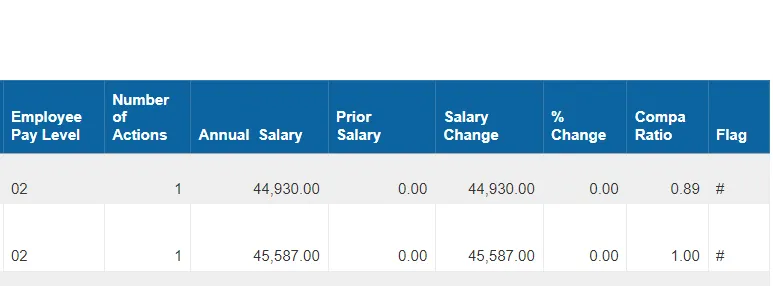
- Salary Increase Monitoring Report Continued….
- Summary: This Reporting tab provides the summary of Actions and Total Dollars Increased by Action Type.
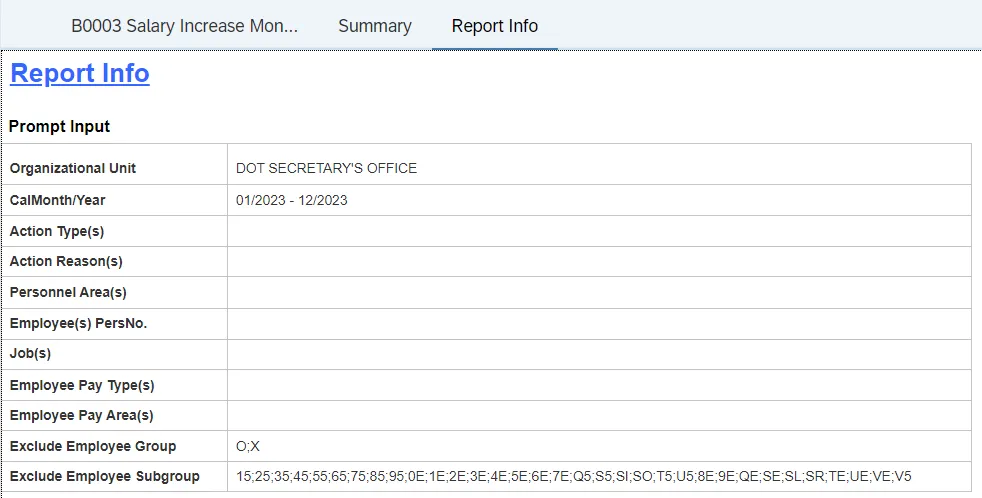
- Report Info: The Report Info tab displays the information about the prompts entered.
Available Objects
This is a list of the available objects that can be added to the report, from the Document Dictionary once in the Design mode:
Dimensions:
- Action Reason
- Action Type
- Age Range
- Agency Hire Date
- Cal Mth
- Cal Mth/Yr
- Cal Qtr
- Cal Yr
- Comments?
- Country
- Effective Date
- Employee
- Employee Group
- Employee Pay Area
- Employee Pay Group
- Employee Pay Level
- Employee Pay type
- Employee Subgroup
- Employee’s Name
- Employment Status
- ESG CAP
- Ethnic Origin
- Fiscal period
- Fiscal year
- Flag
- Gender
- Hourly Pay Indicator
- Job
- Job Branch
- Job Family
- Length of Serv. As of Date of…
- Next Increase Date
- Organizational Unit
- Original Hire Date
- Personnel Area
- Personnel Subarea
- Pos Addr Street
- Pos City
- Pos Country
- Pos County
- Position
- Position Chief
- Prior Emp Pay Group
- Prior Job
- Prior Position
- Processed Date
- SOC Code
- State
- Supv Employee
- Supv Position
- Valid To
Measures:
- Annual Salary
- Emp Reference Salary
- FTE Annual Salary
- Job Reference Salary
- Prior Salary
- Salary Increase Actions
Variables:
- % Change
- Annual Salary
- Emp Ref Salary
- Job Ref Salary
- Number of Actions
- Prior Salary
- Prompt Response Action Reason
- Prompt Response Action Type
- Prompt Response Cal Mth/Yr
- Prompt Response Employee Pay Area
- Prompt Response Employee Pay Type
- Prompt Response Employee PersNo
- Prompt Response Employee Exclude Employee Group
- Prompt Response Employee Exclude Employee Subgroup
- Prompt Response Job
- Prompt Response Organizational Unit
- Prompt Response Personnel Area
- Salary Change
- Compa Ratio
- Emp / Job Ref Salary
- Number of Actions Filter
- Prior Salary Filter
- Salary Change Filter
Special Report Considerations/Features
The salary increases in this report are provided only for specific Action Types like New Hire, Promotion, Reinstatement/Reemployment, Non-Beacon to Beacon, Transfer, Appointment Change, Reallocation, Salary Adjustment, Range Revision, Career Progression, and Band Revision.
- When there are multiple salary changing actions with the same Effective Date, the Infotype 0008 change history table is reviewed to determine which salary change went with which action. However, if for some reason the number of actions does not equal the number of IT0008 change records for that same date, then we are unable to determine which action caused what salary change so the most recent IT0008 salary is shown for all actions on that day. When this scenario happens, the action records will be flagged, and the “Flag” data element (last column in the default report layout) will show an ‘X’ value to signify this.
- Annual Salary and Prior Salary is displayed in two decimal places in this report as the report will have Hourly Salary for Temps
- Compa Ratio is calculated Based on Employee Reference Salary, Job Reference Salary and FTE Annual Salary.
- The Formula for Compa Ratio is “(FTE Annual Salary) divided by (EMP/Job Ref Salary)”. And ‘Emp/Job Ref Salary’ represents the Employee Reference Rate for Banded pay types; for all other pay types, it represents the Job Reference Rate.
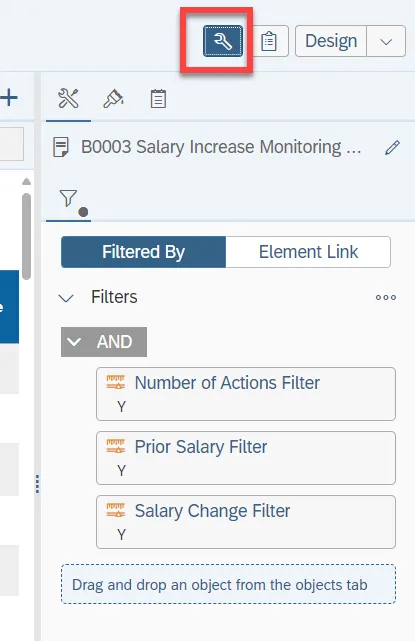
- There is a default filter applied to the report to calculate Salary Increased Only for Qualified Action Reasons.
- If one or more completed PCRs exist for an action, the “Processed Date” available object is populated with the date from the most recent processed PCR action. If no completed PCR exists for the action, the Processed Date is populated with the “Changed on” date from the action Infotype.
Note: Please do not change the default Report Filter as the changes will affect the Report Results.
To check the default filters:
Step 1. Change to Design mode.

Step 2. Click on the tool button to show the data/format panel.
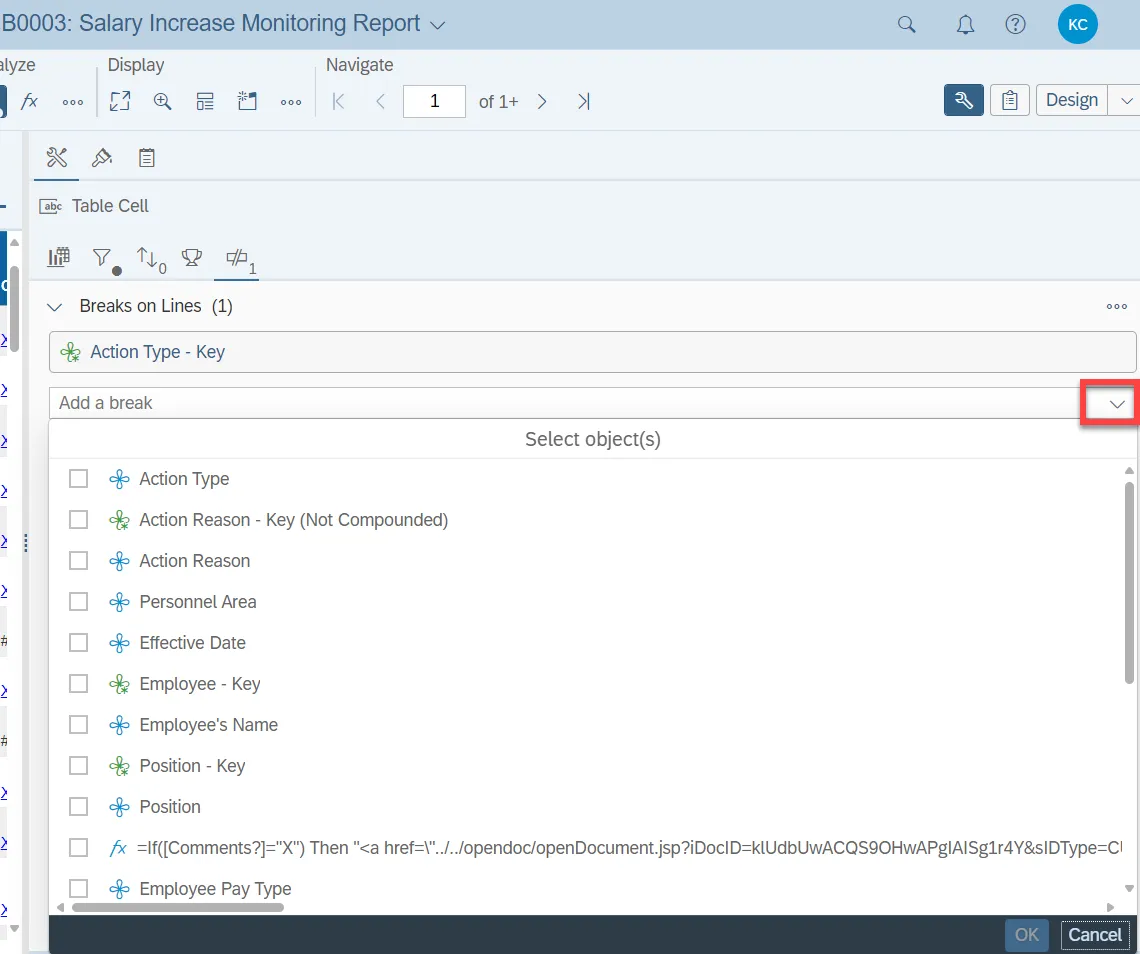
To change the breaks in the Report when exporting the data to Excel:
By default, a break is applied in the report on Action Type to avoid repeated values in the Column.
To see the repeated values for the above column in Excel, remove the break in the report before exporting the data to Excel.
- Make sure that Design Mode is selected.
- Right click on the desired report data column.
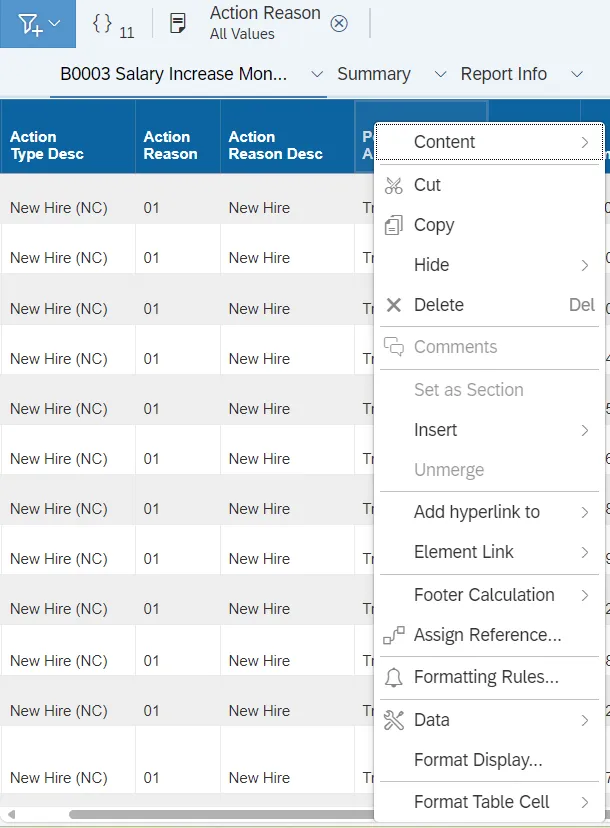
- Click Data.
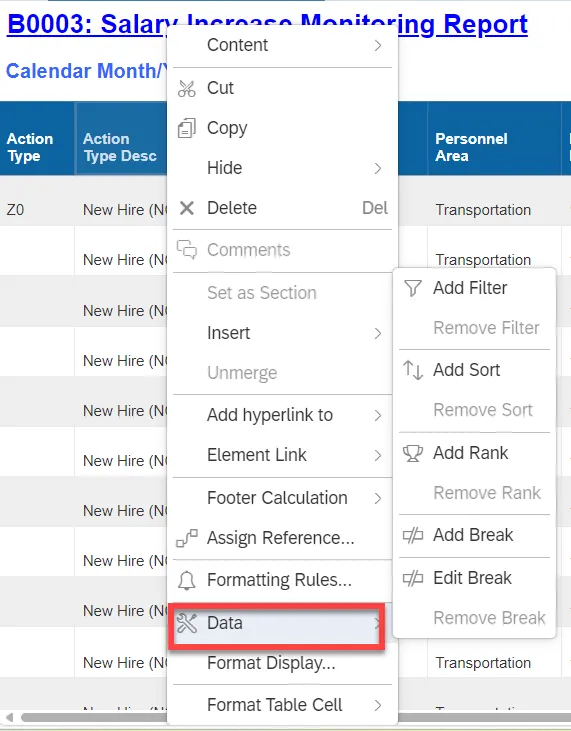
- Click Add Break.
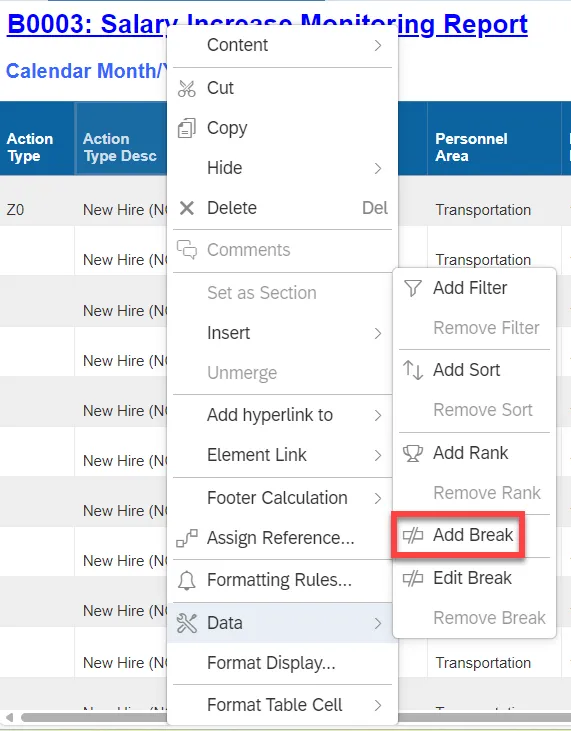
- Select Object(s).